Life-stage TDEE
TDEE for Women: Life-Stage Calorie Adjustments
Most TDEE calculators ignore the luteal phase, pregnancy trimester, breastfeeding, perimenopause, and PCOS. Ours applies cited adjustments for each, so your target reflects the body you actually have.
A woman's TDEE shifts measurably across life stages. The luteal phase adds about 150 kcal/day. Pregnancy adds 340 kcal/day in trimester 2 and 452 kcal/day in trimester 3. Breastfeeding adds 330 to 500 kcal/day above a 1,800 kcal/day floor. Perimenopause subtracts 150 to 200 kcal/day. PCOS lowers BMR by 5 to 7%.
Your daily target
· cal/day
Enter your details and click Calculate
- BMR · cal/day at rest
- BMI ·
- Lean body mass · kg
Pick your goal
Macros at maintenance
30% protein · 40% carbs · 30% fat
Numbers are estimates. Eat at your target for 2 to 3 weeks, track weight, and adjust by ±100 cal/day if it does not match your real maintenance. See how accurate is TDEE?
Show advanced metrics 12 metrics · 7 formulas · 2D macro selector · life-stage
All metrics
Calculate above to populate the full metric table.
All 7 BMR formulas (side-by-side)
Mifflin–St Jeor · Harris–Benedict (revised) · Katch–McArdle · Cunningham · Average · Simple multiplier · Custom
TDEE across activity levels
See how much your TDEE changes between sedentary and athlete. Highlighted bar is your current selection.
Macros: 2D selector
Goal × carb-split matrix: Cut / Maintain / Bulk × Low / Moderate / High carb.
Life-stage adjustments
Luteal phase · Pregnancy (T1/T2/T3) · Breastfeeding · Perimenopause · PCOS
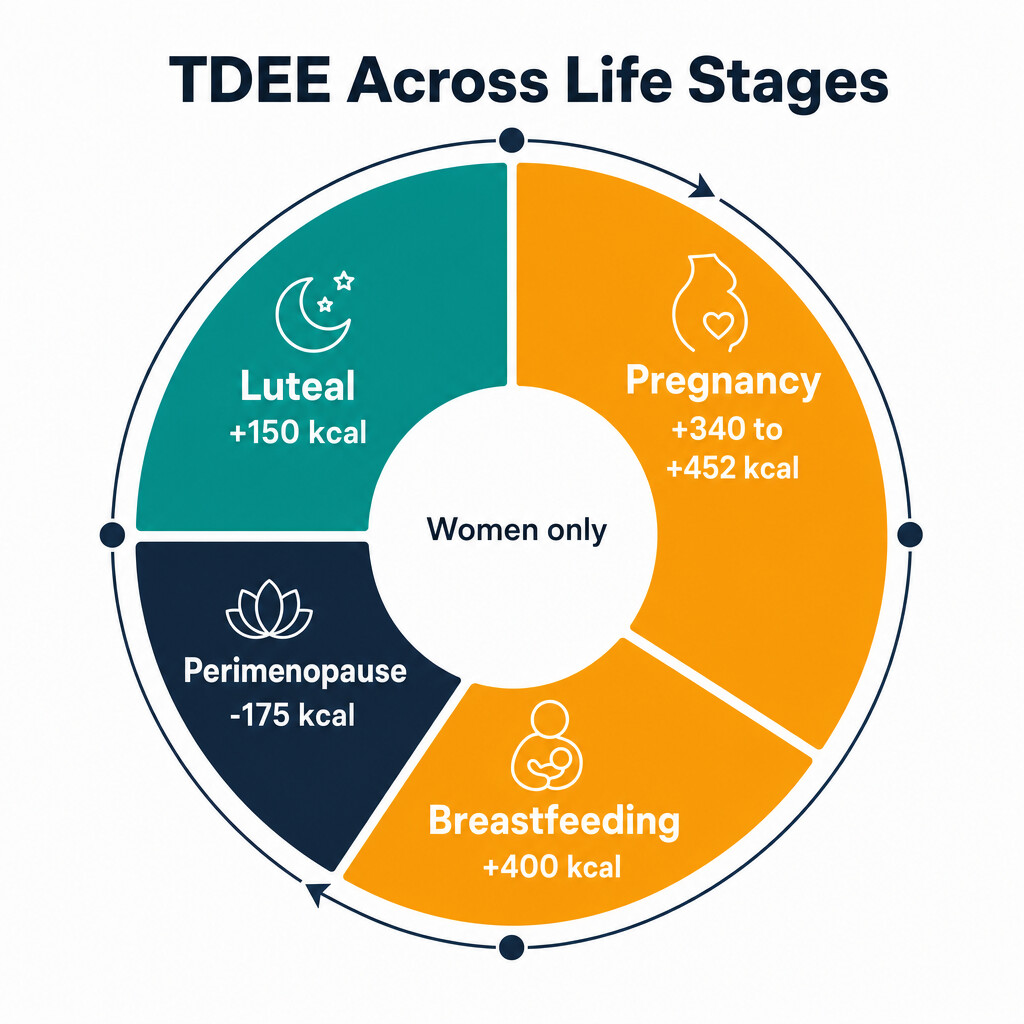
Open the main TDEE calculator, enable Power Mode, and pick your life stage from the dropdown. Each adjustment below is drawn from a primary source, and each links to a dedicated calculator if you want to skip straight to that life stage.
Life-stage TDEE adjustments and their sources
Luteal phase: +150 kcal/day
The luteal phase runs post-ovulation to pre-period, roughly days 15 to 28 of a 28-day cycle. Progesterone raises core body temperature about 0.3 to 0.5°C and lifts resting metabolic rate by about 150 kcal/day. Use the luteal phase calorie calculator to apply this adjustment on its own.
Sources: Reed et al., 1988 (Am J Clin Nutr, PMID: 3414579); Henry et al., 2001 (Br J Nutr).
Pregnancy by trimester
- Trimester 1: +0 kcal/day. Energy needs do not measurably change in the first 12 weeks.
- Trimester 2: +340 kcal/day.
- Trimester 3: +452 kcal/day.
Apply trimester adjustments directly in the pregnancy TDEE calculator.
Source: Institute of Medicine (IOM), 2002. Dietary Reference Intakes for Energy, Carbohydrate, Fiber, Fat, Fatty Acids, Cholesterol, Protein, and Amino Acids.
Breastfeeding: +330 to +500 kcal/day, with a 1,800 kcal floor
Exclusive breastfeeding raises caloric needs by 330 to 500 kcal/day above pre-pregnancy baseline. The WHO and IOM both set 1,800 kcal/day as the safety floor during the breastfeeding window regardless of weight-loss goals. Going below that floor threatens milk supply and infant nutrition, often within days. Run the numbers in the breastfeeding calorie calculator.
Sources: WHO Infant Feeding Recommendations; IOM 2002; American Academy of Pediatrics policy statement on breastfeeding.
Perimenopause: -150 to -200 kcal/day
Estrogen decline through perimenopause (typically late 40s) lowers BMR by 150 to 200 kcal/day and shifts fat distribution toward the abdomen. The calculator subtracts 175 kcal/day by default. The perimenopause TDEE calculator handles this adjustment specifically.
Sources: Lovejoy et al., 2008 (Int J Obes, PMID: 18283284); North American Menopause Society 2022 position statement.
PCOS: -5% to -7% of BMR
Polycystic Ovary Syndrome reduces metabolic efficiency, likely through insulin resistance and altered thyroid signaling. Research puts the BMR reduction at 5 to 7%. The calculator applies a 6% BMR reduction by default when PCOS is selected. The PCOS TDEE calculator isolates this adjustment.
Sources: Jakubowicz et al., 2013 (Clin Sci); multiple meta-analyses through 2024.
Why life-stage TDEE matters
A 145 lb woman in her luteal phase burns about 150 kcal/day more than the same woman in her follicular phase. A pregnant woman in her third trimester needs roughly 450 kcal/day more than her pre-pregnancy baseline. A perimenopausal woman burns about 175 kcal/day less than she did at 35 at the same activity level.
A single unadjusted TDEE estimate across these stages mis-feeds you by 150 to 450 kcal/day. Compounded over weeks, the result is predictable: unexpected weight loss during breastfeeding, frustrating plateaus during the luteal phase, and slow weight creep during perimenopause.
Cycle tracking and the luteal window
If you track your menstrual cycle with Natural Cycles, Clue, Flo, or similar, match the luteal-phase adjustment to your real luteal window. The standard 14-day length is an average. Some women run a shorter 10 to 12 day luteal phase, and a few run longer. Use your tracker\'s ovulation estimate, count forward to your next period, and apply the +150 kcal during those days.
How to use this page
Calculate your baseline TDEE in the main calculator, apply the life-stage adjustment that fits your current biology, then calibrate empirically over 2 to 3 weeks using our three-week calibration protocol. The adjustments above are population averages. Your scale is the ground truth.