Concepts
BMR vs TDEE: The Difference, Explained Clearly
BMR is the energy you burn at rest. TDEE is the energy you burn living. Here is the precise relationship and how to apply both to a calorie target.
BMR (Basal Metabolic Rate) is the calories your body burns at complete rest to keep your heart, brain, and organs running. TDEE (Total Daily Energy Expenditure) is BMR plus the energy used to digest food plus every kilocalorie spent on physical activity. TDEE is typically 1.2 to 1.9 times your BMR.
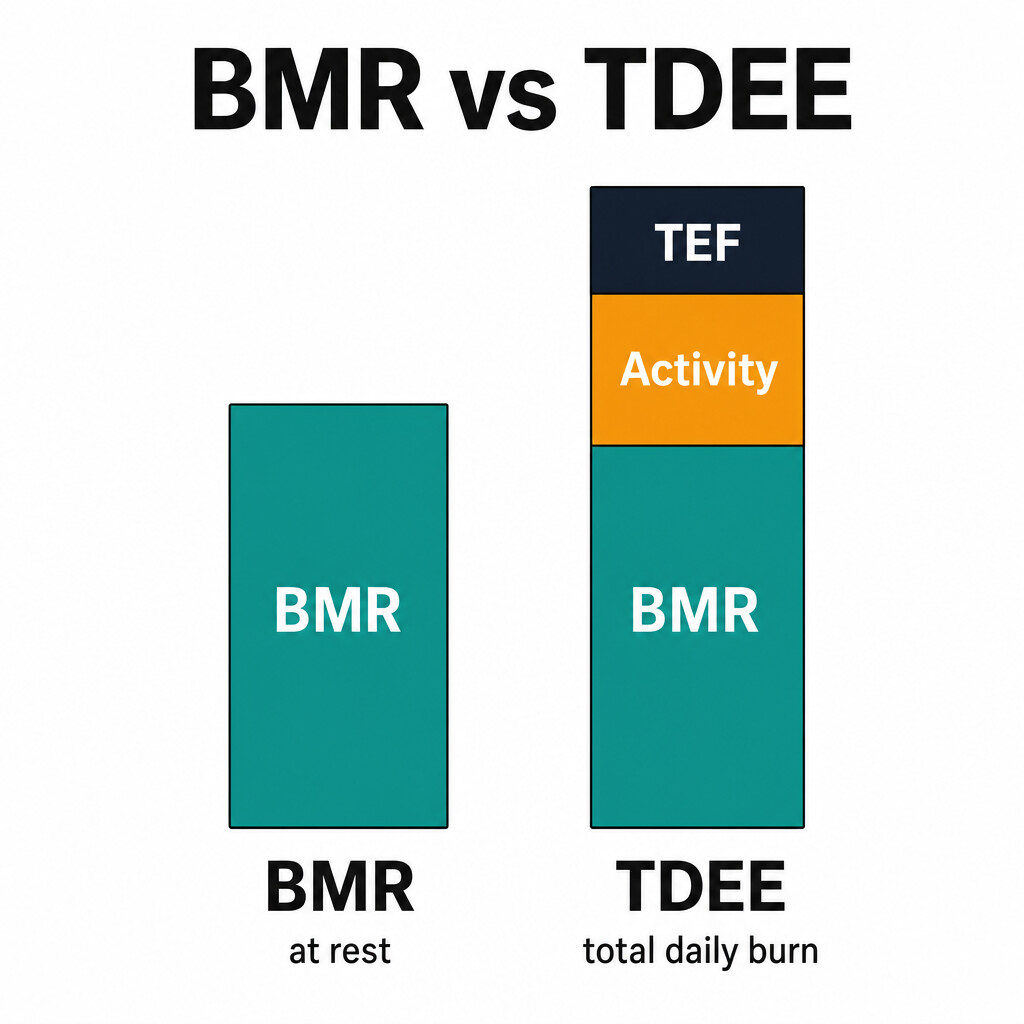
The exact relationship between BMR and TDEE
TDEE = BMR × Activity Factor
The activity factor is a multiplier that ranges from 1.2 (fully sedentary) to 1.9 (elite athlete). For a typical adult the numbers shake out like this:
- BMR: roughly 1,400 to 1,800 kcal/day
- TDEE: roughly 2,000 to 3,200 kcal/day
- Activity factor: 1.4 to 1.7 for most people
Use our BMR calculator if you only need the resting number, or jump straight to the TDEE calculator for the full daily burn.
When BMR is the number you want
- Setting a minimum calorie floor. Eating below BMR for weeks stresses metabolism, suppresses hormones, and burns through lean muscle.
- Hospital nutrition. Bedridden patients with no meaningful activity are dosed at BMR plus a small stress factor.
- Mechanistic understanding. BMR reflects your underlying metabolism. TDEE layers behavior on top.
When TDEE is the number you want
- Setting daily calorie targets. For fat loss, subtract 250 to 500 kcal from TDEE. For muscle gain, add 200 to 300 kcal.
- Meal planning. Your eating budget is TDEE-based, not BMR-based.
- Tracking weight change. Eating at TDEE maintains weight. Under TDEE loses. Over TDEE gains.
The most common mistake
Many people read "BMR is what I burn" and assume BMR is what they should eat. That logic is wrong. BMR is what you burn at zero activity, and you are almost never at zero activity. Eating at BMR while living a normal life puts you in a 400 to 800 kcal/day deficit, which is too aggressive for sustained fat loss.
The right framing: BMR is your baseline metabolism. TDEE is your actual daily burn. Set your calorie target against TDEE, not BMR.
How to use both numbers together
Calculate both. Treat BMR as the floor you will not eat below and TDEE as the budget you will eat against. If your TDEE estimate feels off, run the three-week calibration protocol to dial it in. If your activity level is hard to pin down, the activity level guide gives you a more precise multiplier than the standard five buckets.