Formula
Mifflin–St Jeor Equation
The Mifflin–St Jeor equation is the most validated BMR formula for healthy adults. Published in 1990, it is the default behind nearly every modern TDEE calculator, including this one.
The Mifflin–St Jeor equation calculates basal metabolic rate from sex, weight in kilograms, height in centimeters, and age in years. For men: BMR = (10 x weight) + (6.25 x height) - (5 x age) + 5. For women: BMR = (10 x weight) + (6.25 x height) - (5 x age) - 161. Mifflin et al. published it in the American Journal of Clinical Nutrition (1990;51(2):241-247, PMID 2305711), where it outperformed Harris–Benedict on accuracy.
Your daily target
· cal/day
Enter your details and click Calculate
- BMR · cal/day at rest
- BMI ·
- Lean body mass · kg
Pick your goal
Macros at maintenance
30% protein · 40% carbs · 30% fat
Numbers are estimates. Eat at your target for 2 to 3 weeks, track weight, and adjust by ±100 cal/day if it does not match your real maintenance. See how accurate is TDEE?
Show advanced metrics 12 metrics · 7 formulas · 2D macro selector · life-stage
All metrics
Calculate above to populate the full metric table.
All 7 BMR formulas (side-by-side)
Mifflin–St Jeor · Harris–Benedict (revised) · Katch–McArdle · Cunningham · Average · Simple multiplier · Custom
TDEE across activity levels
See how much your TDEE changes between sedentary and athlete. Highlighted bar is your current selection.
Macros: 2D selector
Goal × carb-split matrix: Cut / Maintain / Bulk × Low / Moderate / High carb.
Life-stage adjustments
Luteal phase · Pregnancy (T1/T2/T3) · Breastfeeding · Perimenopause · PCOS
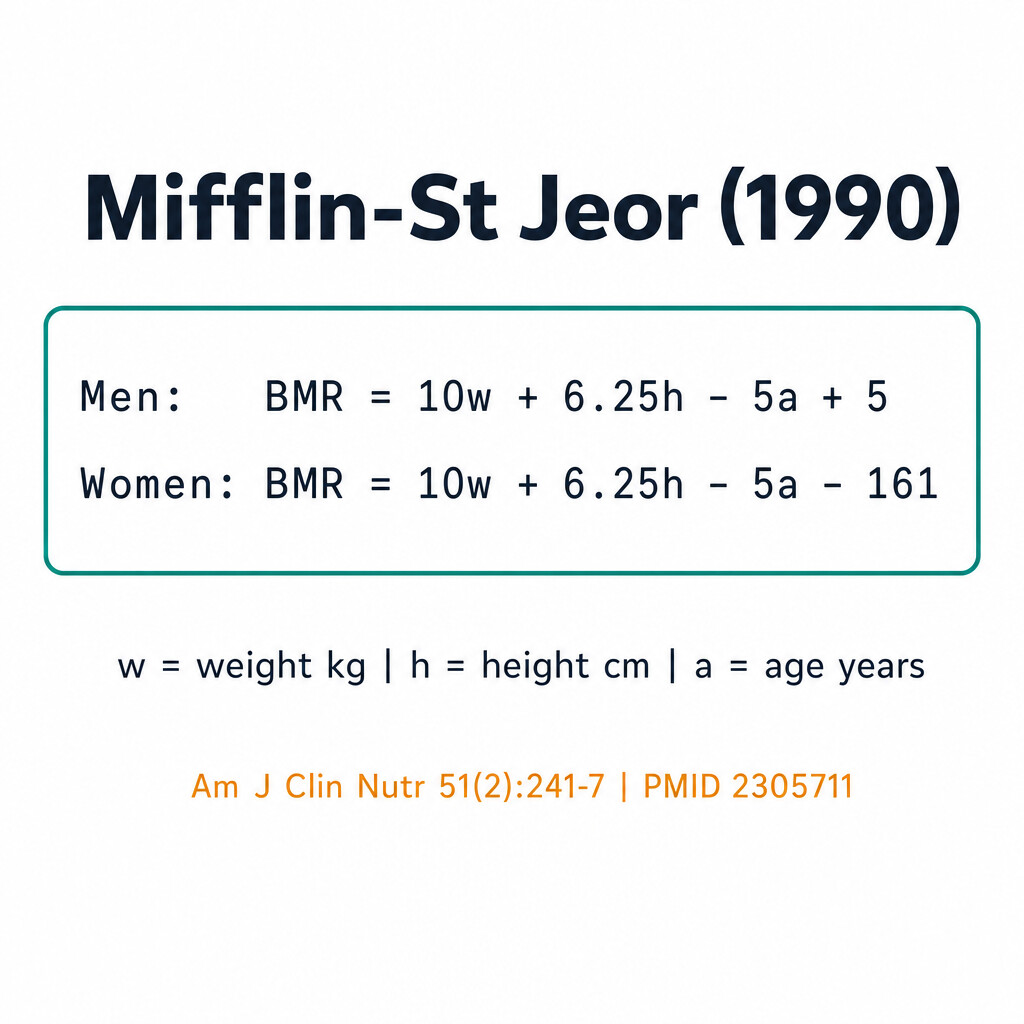
The Mifflin–St Jeor formula
Men:   BMR = (10 x weight kg) + (6.25 x height cm) - (5 x age) + 5
Women: BMR = (10 x weight kg) + (6.25 x height cm) - (5 x age) - 161
Plug your numbers in, or use the BMR calculator to skip the arithmetic.
Worked examples
30-year-old man, 80 kg, 180 cm:
BMR = (10 x 80) + (6.25 x 180) - (5 x 30) + 5
    = 800 + 1,125 - 150 + 5
    = 1,780 kcal/day
30-year-old woman, same height and weight:
BMR = (10 x 80) + (6.25 x 180) - (5 x 30) - 161
    = 800 + 1,125 - 150 - 161
    = 1,614 kcal/day
How to use Mifflin–St Jeor for daily calories
- Calculate BMR with the equation above.
- Multiply by your activity multiplier (1.2 to 1.9). Use the activity level guide to pick honestly.
- The result is TDEE. Subtract 250–500 kcal for fat loss using the calorie deficit calculator, or add 250–500 kcal for muscle gain.
- Round the final number to the nearest 50 kcal. The formula is not precise enough to justify three-digit accuracy.
Source paper
Mifflin MD, St Jeor ST, Hill LA, Scott BJ, Daugherty SA, Koh YO. A new predictive equation for resting energy expenditure in healthy individuals. American Journal of Clinical Nutrition. 1990 Feb;51(2):241-247.
- PMID: 2305711
- DOI: 10.1093/ajcn/51.2.241
Why Mifflin–St Jeor replaced Harris–Benedict
Harris–Benedict (1919, revised 1984) was the previous standard. Frankenfield, Roth-Yousey, and Compher reviewed both in the Journal of the American Dietetic Association (2005;105(5):775-789) and found:
- Harris–Benedict overestimates BMR by an average of 50–80 kcal/day in modern populations.
- Mifflin–St Jeor lands within plus or minus 10% for 82% of healthy individuals, compared with roughly 69% for Harris–Benedict.
- Mifflin's 498-subject Nevada sample reflects late-20th-century body sizes far better than the 239 subjects Harris and Benedict measured between 1909 and 1919.
Where the Mifflin–St Jeor equation breaks down
This is a population formula. Accuracy degrades at the extremes:
- Very lean or very muscular bodies: use Katch–McArdle (lean-mass-based) instead.
- Obesity (BMI greater than 40): the formula slightly overestimates. Some research recommends a fat-free-mass equation.
- Adults over 75: validation thins. Plan around a 10% error band.
- Competitive athletes: often need a higher activity multiplier than the standard 1.9 cap allows.
How accurate is Mifflin–St Jeor for you personally?
Roughly plus or minus 10% for the typical adult. On a 1,500 kcal BMR, that is 150 kcal in either direction. To find your personal correction factor, run the 3-week empirical calibration in how accurate is TDEE, or compare BMR and TDEE side by side in BMR vs TDEE.