Accuracy
How Accurate Is a TDEE Calculator?
Formula estimates miss by more than 250 kcal/day for at least half of users. Here is the data, the reasons, and a three-week protocol that calibrates the formula to your actual TDEE.
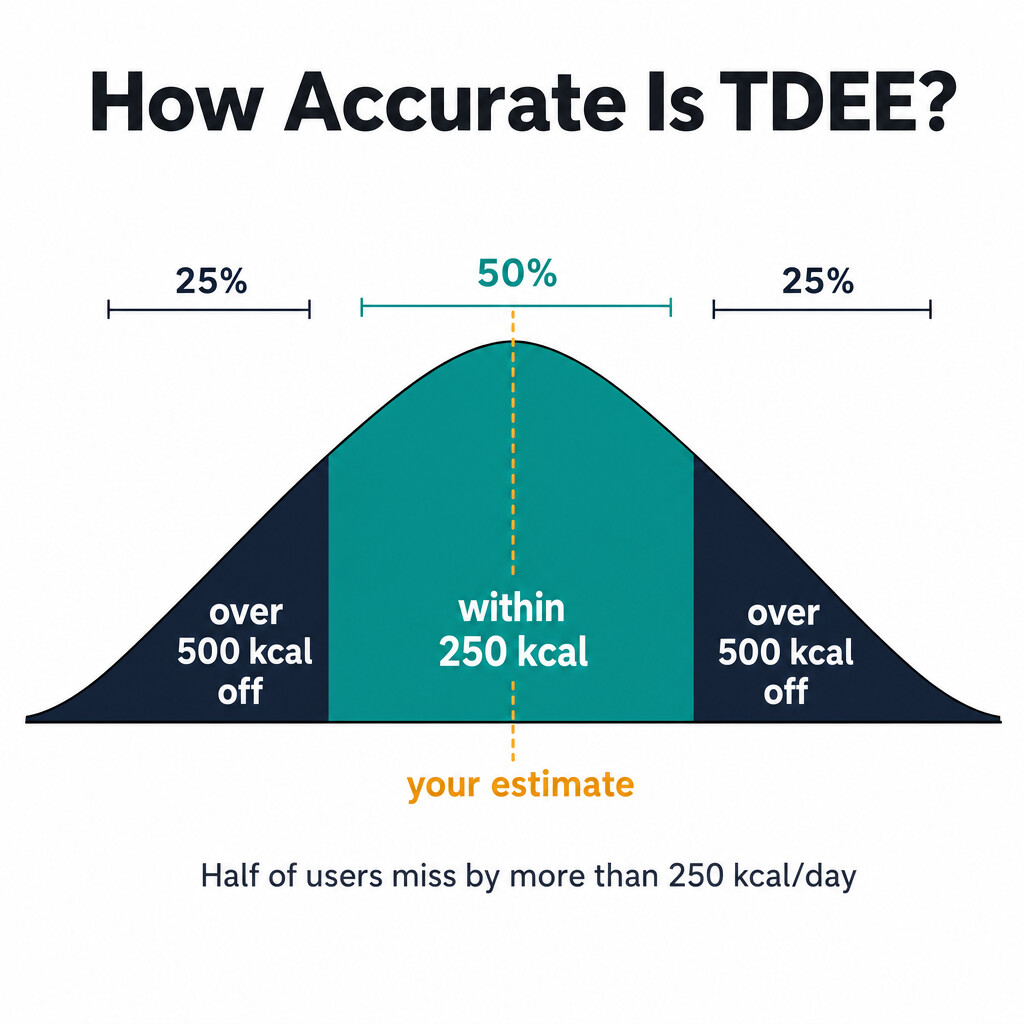
TDEE calculators miss by more than 250 kcal/day for at least half of users and by more than 500 kcal/day for a meaningful minority (MacroFactor user data, 2024). Treat the calculator estimate as a starting point. Eat at that estimate for 2 to 3 weeks, weigh yourself daily, then adjust by ±100 kcal/day until your weight is stable.
Most TDEE calculators present a single number with quiet authority. The truth is messier, and you deserve to see it before you build a diet around the result.
The TDEE error distribution
MacroFactor, a nutrition app that tracks real-world calorie intake against actual weight change, has published accuracy data on tens of thousands of users. The pattern is consistent across populations.
- About 50% of users: formula off by more than 250 kcal/day
- About 25% of users: formula off by more than 500 kcal/day
- About 10% of users: formula off by more than 750 kcal/day
Two error sources dominate. The first is activity-level overestimation: roughly 80% of users pick a multiplier at least one bucket too high. The second is individual metabolic variation: BMR varies ±10% between people of identical height, weight, age, and sex.
Why TDEE estimates are imperfect
- BMR formulas are population averages. Mifflin–St Jeor was derived from 498 subjects in 1990. Your individual BMR can sit ±150 kcal/day from the formula prediction.
- Activity factors are crude buckets. "Moderate (3 to 5 workouts/week)" covers a four-hour-per-week jogger and an eight-hour-per-week strength athlete. Real activity differs by 300 to 500 kcal/day inside that one bucket.
- NEAT varies wildly. Non-Exercise Activity Thermogenesis (fidgeting, posture, errands) ranges ±400 kcal/day between otherwise identical people (Levine, 1999, Science).
- The thermic effect of food depends on macros. Protein burns roughly 25% of its calories during digestion. Fat burns about 3%. A high-protein day adds 80 to 120 kcal of TEF over a high-fat day at the same calorie intake.
- Metabolic adaptation is real. Sustained deficits suppress TDEE 10 to 15% beyond what the math predicts, documented in long-term dieters and the Biggest Loser follow-up study (Fothergill et al., 2016).
The three-week TDEE calibration protocol
- Week 0. Calculate your TDEE with our main calculator. This is your starting estimate.
- Weeks 1 to 3. Eat at the estimated TDEE every day. Weigh yourself every morning, fasted, after using the bathroom. Track everything you eat.
- End of week 3. Compare your average daily weight in week 1 against week 3.
- Within ±0.5 lb of stable: your TDEE estimate is accurate.
- Dropped more than 0.5 lb: your real TDEE is higher than the estimate. Add 100 to 200 kcal/day.
- Gained more than 0.5 lb: your real TDEE is lower than the estimate. Subtract 100 to 200 kcal/day.
- Repeat every 4 weeks for two cycles. By the end your TDEE is calibrated to within roughly 100 kcal/day, which is better than any formula can manage.
How to cut the biggest error source: activity level
Activity-level overestimation is the single largest source of formula error. Most calculators offer five vague buckets ("light", "moderate", "very active"), and most people round up. We built an eight-question lifestyle quiz that outputs a precise numerical multiplier between 1.20 and 1.90, which eliminates most of the bucket-mismatch error before you even start the calibration protocol.
What to do if your numbers still feel wrong
If three weeks of careful tracking still leaves your weight drifting, two factors usually explain it. Check that you are weighing food rather than eyeballing portions (portion size error alone runs 20 to 30% in untrained eaters), and confirm your activity multiplier against the activity guide. After that, recalibrate. The formula is a starting point. Your scale is the ground truth.