Macros
Macro Calculator
Get your daily protein, carb, and fat targets in grams. The macro calculator below picks the split that matches your goal (cut, maintain, or bulk) and your carb preference (low, moderate, or high).
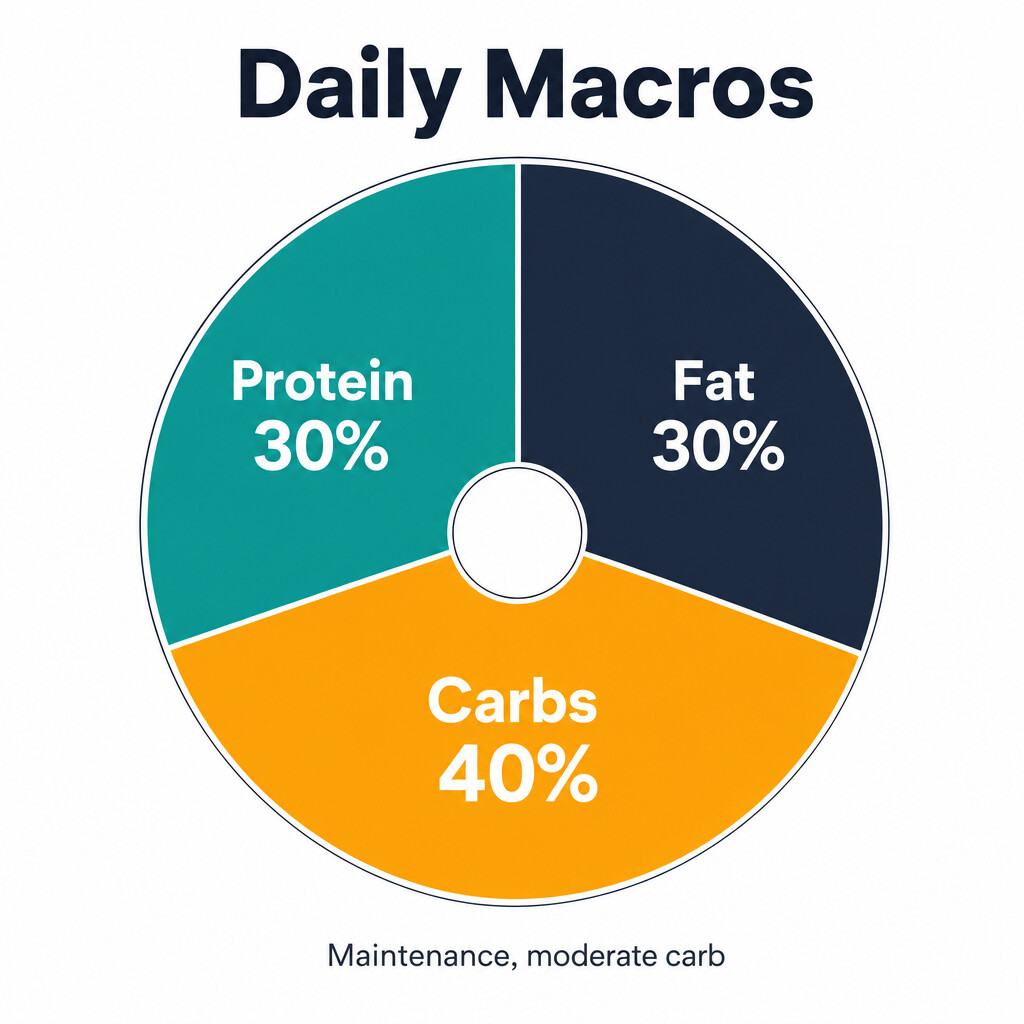
Macros, short for macronutrients, are the breakdown of daily calories into protein, carbohydrates, and fat. Standard starting splits run 40/30/30 for cutting, 30/40/30 for maintenance, and 25/50/25 for bulking. Protein and fat each have a floor that protects muscle and hormones: 0.7 g/lb protein and 0.3 g/lb fat. Carbs fill the remaining calories.
Your daily target
· cal/day
Enter your details and click Calculate
- BMR · cal/day at rest
- BMI ·
- Lean body mass · kg
Pick your goal
Macros at maintenance
30% protein · 40% carbs · 30% fat
Numbers are estimates. Eat at your target for 2 to 3 weeks, track weight, and adjust by ±100 cal/day if it does not match your real maintenance. See how accurate is TDEE?
Show advanced metrics 12 metrics · 7 formulas · 2D macro selector · life-stage
All metrics
Calculate above to populate the full metric table.
All 7 BMR formulas (side-by-side)
Mifflin–St Jeor · Harris–Benedict (revised) · Katch–McArdle · Cunningham · Average · Simple multiplier · Custom
TDEE across activity levels
See how much your TDEE changes between sedentary and athlete. Highlighted bar is your current selection.
Macros: 2D selector
Goal × carb-split matrix: Cut / Maintain / Bulk × Low / Moderate / High carb.
Life-stage adjustments
Luteal phase · Pregnancy (T1/T2/T3) · Breastfeeding · Perimenopause · PCOS
Open Power Mode on the macro calculator above for the nine-preset selector (cut, maintain, or bulk crossed with low, moderate, or high carb).
The macro hierarchy: calories, protein, fat, carbs
- Set total calories first. Subtract 500 from maintenance to cut, hold maintenance to recomp, or add 250 to 500 to bulk. Calories drive whether you gain or lose weight; macros decide what kind of weight.
- Lock protein second. Aim for 0.7 to 1.0 g per pound of body weight (1.6 to 2.2 g/kg). Push the upper end during a cut to protect muscle.
- Set the fat floor third. Stay above 0.3 g per pound (0.7 g/kg). Drop below this and testosterone, estrogen, and satiety hormones suffer.
- Carbs fill the rest. Whatever calories remain after protein and fat go to carbs. Carbs are the lever for training performance, glycogen, and energy.
Why protein, fat, then carbs?
Protein is the only macro your body cannot synthesize from the other two. Fall short and you lose muscle, even in a calorie surplus. Fat hits a hormonal floor below which testosterone, estrogen, and other hormones drop measurably (Dorgan et al., 1996; Hämäläinen et al., 1984). Carbs are the flexible macro: the body adapts to a wide range, and the right level depends on training volume and personal preference.
How much protein do you actually need?
Schoenfeld and Aragon's 2018 meta-analysis (J Int Soc Sports Nutr) identified 1.6 g/kg/day as the threshold where muscle-building benefits plateau in trained lifters. Helms et al. (2014) recommend 2.3 to 3.1 g/kg of fat-free mass during aggressive cuts to protect lean tissue. In practice: 1.6 g/kg covers maintenance, 1.8 to 2.2 g/kg suits most cuts and bulks, and 2.4 g/kg is the upper end for lean athletes in a steep deficit.
Practical macro examples
180 lb male, cutting, moderate carb (40/30/30)
- TDEE 2,600 kcal, cut target 2,100 kcal
- Protein: 2,100 × 0.40 ÷ 4 = 210 g (1.17 g/lb, strong for muscle preservation)
- Carbs: 2,100 × 0.30 ÷ 4 = 158 g
- Fat: 2,100 × 0.30 ÷ 9 = 70 g (0.39 g/lb, above the hormonal floor)
145 lb female, maintenance, higher carb (25/50/25)
- TDEE 2,000 kcal, maintenance target 2,000 kcal
- Protein: 2,000 × 0.25 ÷ 4 = 125 g (0.86 g/lb, solid for active women)
- Carbs: 2,000 × 0.50 ÷ 4 = 250 g
- Fat: 2,000 × 0.25 ÷ 9 = 56 g (0.39 g/lb, above the floor)
Spread protein across the day
Hit 4 to 5 meals at 0.4 to 0.55 g/kg protein each to maximize muscle protein synthesis. Areta et al. (2013) showed that four 20 g doses of protein every three hours outperformed two 40 g doses or eight 10 g doses for 12-hour muscle protein synthesis. Cluster carbs around training for performance and recovery; spread fat evenly to slow gastric emptying and stretch satiety.
Use these macros for these decisions
Your macro targets answer three daily questions. How much chicken, fish, or whey hits the protein number? Most lifters need 25 to 50 g of protein at each main meal. How much rice, oats, or potato fits the carb number? Pre- and post-training meals get the largest carb portions. How much olive oil, nuts, or fatty fish hits the fat floor without crowding out carbs? Cook with measured oil rather than free-pouring. For the underlying calorie target, see the BMR calculator for women, men, and athletes; women may also want the TDEE-for-women breakdown.