TDEE inputs
Activity Level Guide for TDEE
Choosing the wrong activity level is the single biggest source of TDEE error. About 80% of users pick one level too high. This activity level guide walks through each multiplier with concrete examples, then hands you a quiz that outputs a precise number between 1.20 and 1.90.
Activity multipliers convert your BMR into TDEE. Use 1.2 for a sedentary desk job, 1.375 for light activity (1–3 workouts per week), 1.55 for moderate training (3–5 workouts per week), 1.725 for heavy training (6–7 workouts per week), and 1.9 for athletes or hard physical labor. Most people overestimate by one full level, which inflates daily calories by 250–300 kcal.
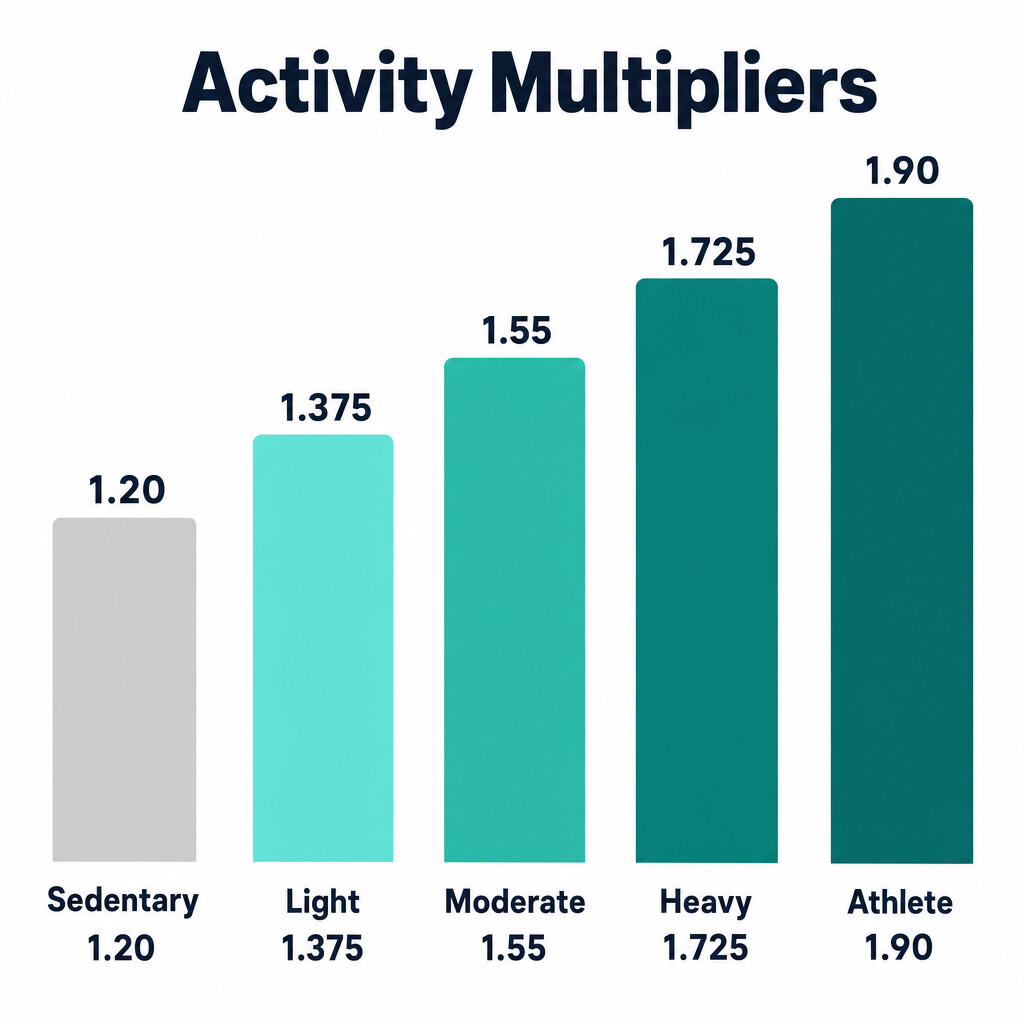
The 5 standard activity multipliers
Each multiplier scales your BMR (see the BMR calculator and the Mifflin-St Jeor equation) into total daily energy expenditure. Read the examples, then pick the one that sounds like your actual week, not your aspirational week.
1.2: Sedentary
Description: Desk job. Minimal walking. No structured exercise.
You are this if: You drive to work, sit at a computer all day, and do not exercise. Your evening is mostly screen-based. Daily steps stay under 4,000.
Common mistake: Walking to the kitchen and back does not make you "lightly active." If you do not train, you are sedentary.
1.375: Light
Description: 1–3 days of light activity per week plus some incidental walking.
You are this if: You walk 30 minutes most days, or do gentle yoga 1–3 times per week. Daily steps land between 5,000 and 7,000. No structured strength or cardio program.
1.55: Moderate
Description: 3–5 days of moderate-intensity training per week, with active habits between sessions.
You are this if: You strength train 3–4 days per week, or run 4–5 days per week. Daily steps land between 8,000 and 10,000. This is where committed gym-goers sit, not "heavy."
1.725: Heavy
Description: 6–7 days of hard training per week, or a physically demanding job.
You are this if: You train 6–7 days per week at high intensity and stay active outside the gym. Or you work construction, nursing, or food service, and still train regularly.
1.9: Athlete
Description: Two-a-day training, or extreme physical labor on top of structured workouts.
You are this if: You compete in endurance sport, train at the collegiate or professional level, or do labor work and train hard daily. Rare. Most self-described "athletes" still fit best at 1.725.
Why most people overestimate their activity level
The "moderate" bucket (1.55) acts as a gravitational center. People who train 3 days per week pick it. So do people who train 5 days, 6 days, and even 1–2 days per week. Aspiration beats accuracy.
That single error, picking 1.55 when 1.375 is true, adds about 250–300 kcal per day to your TDEE estimate. Eat at the inflated number for a month and you over-eat by roughly 2 pounds of unwanted weight. See why am I not losing weight for the full diagnostic chain.
How to use your activity level
- Multiply your BMR by the matching activity multiplier to get TDEE.
- Subtract 250–500 kcal for fat loss, or add 250–500 kcal for muscle gain. See the calorie deficit calculator and the maintenance calorie calculator for goal-specific targets.
- Eat at the resulting number for three weeks. Track weight every morning.
- If the trend disagrees with the math, drop one activity level and recalibrate.
The quiz beats the dropdown
The 8-question quiz on this site scores job activity, daily steps, training frequency, intensity, duration, hobbies, commute, and a self-honesty check, then outputs a 2-decimal multiplier between 1.20 and 1.90. That value lands between the standard buckets, where most real lifestyles actually sit.
Sample output: 1.42. Use it as a more honest input to the TDEE calculator than the dropdown alone.