Weight loss
Calorie Deficit Calculator
Find the calorie deficit that fits your goal. The calculator below picks a sustainable pace, projects time-to-goal, and flags when your target dips below safe limits.
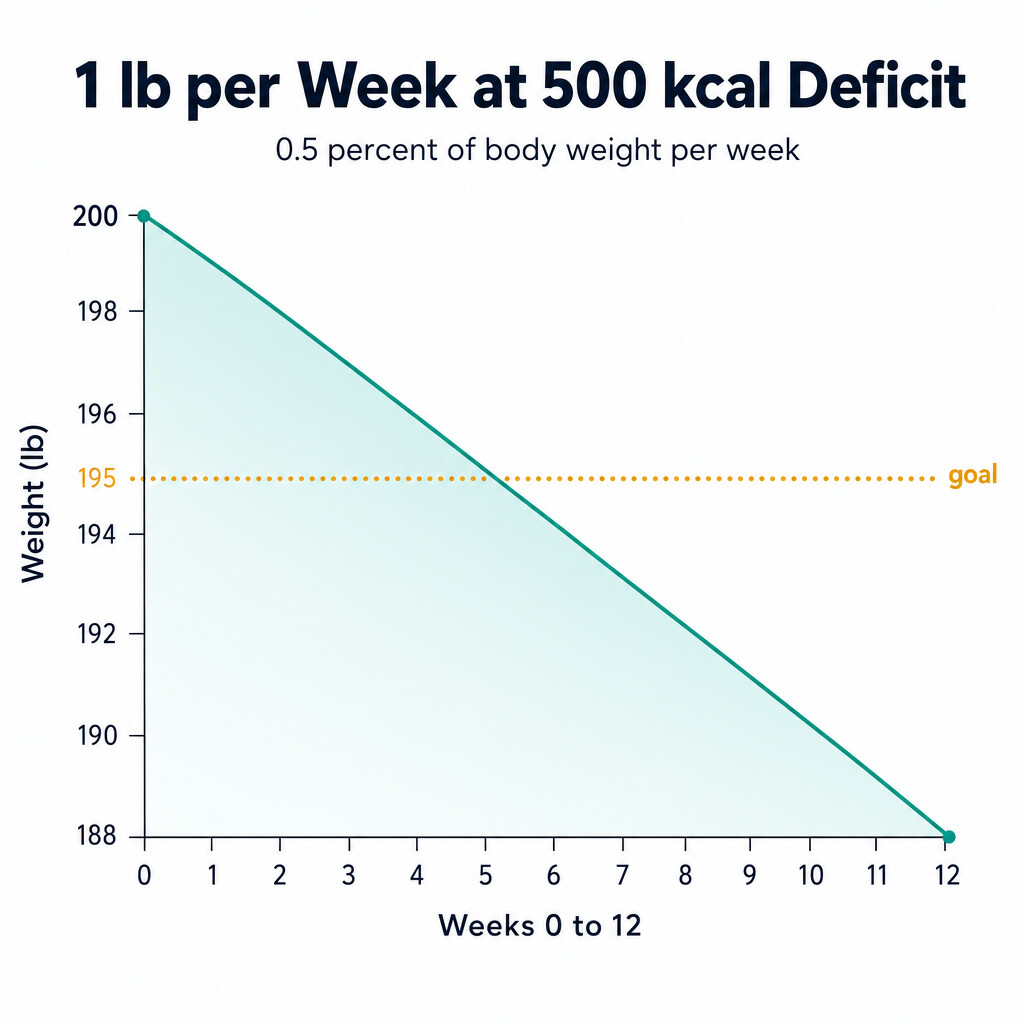
A calorie deficit is the gap between calories burned and calories eaten, and that gap is what creates fat loss. One pound of body fat stores about 3,500 kcal, so a daily deficit of 500 kcal produces roughly one pound per week of loss. Hold your weekly loss between 0.5 and 1 percent of body weight; anything faster sacrifices muscle and triggers metabolic adaptation.
Your daily target
· cal/day
Enter your details and click Calculate
- BMR · cal/day at rest
- BMI ·
- Lean body mass · kg
Pick your goal
Macros at maintenance
30% protein · 40% carbs · 30% fat
Numbers are estimates. Eat at your target for 2 to 3 weeks, track weight, and adjust by ±100 cal/day if it does not match your real maintenance. See how accurate is TDEE?
Show advanced metrics 12 metrics · 7 formulas · 2D macro selector · life-stage
All metrics
Calculate above to populate the full metric table.
All 7 BMR formulas (side-by-side)
Mifflin–St Jeor · Harris–Benedict (revised) · Katch–McArdle · Cunningham · Average · Simple multiplier · Custom
TDEE across activity levels
See how much your TDEE changes between sedentary and athlete. Highlighted bar is your current selection.
Macros: 2D selector
Goal × carb-split matrix: Cut / Maintain / Bulk × Low / Moderate / High carb.
Life-stage adjustments
Luteal phase · Pregnancy (T1/T2/T3) · Breastfeeding · Perimenopause · PCOS
The math behind a calorie deficit
Daily deficit (kcal) × 7 days = weekly deficit
Weekly deficit ÷ 3,500 = pounds of fat lost per week
The 3,500-kcal-per-pound rule (Wishnofsky, 1958) is an approximation. Real-world loss runs 10 to 20 percent slower because of metabolic adaptation, especially past week four. Plan for the model, then recalibrate against the scale every two to three weeks.
Recommended calorie deficits by pace
- 0.25 lb/week (gradual): 125 kcal/day deficit. Slow but sustainable. Minimal hunger, no measurable muscle loss, no metabolic adaptation. Best for the last 5 to 10 pounds and for body recomposition.
- 0.5 lb/week (moderate): 250 kcal/day deficit. The sweet spot for most lifters. Easy adherence, full training performance, near-zero lean mass loss with adequate protein.
- 1 lb/week (standard): 500 kcal/day deficit. The most common target. Some hunger and minor performance dips, but muscle loss stays under 5 percent of total loss when you hit 1.6 to 2.2 g/kg protein and lift heavy.
- 1.5 lb/week (aggressive): 750 kcal/day deficit. Higher hunger, sleep can suffer, and 15 to 20 percent of loss comes from muscle without high protein plus resistance training. Reserve for short cuts.
- 2 lb/week (very aggressive): 1,000 kcal/day deficit. Significant muscle loss risk, metabolic adaptation accelerates, and adherence collapses for most people within four weeks. Use only under medical supervision or at higher body fat percentages.
Never eat below your BMR
Your BMR is the safety floor. Sustained intake below BMR triggers metabolic adaptation: your body downregulates thyroid output, drops NEAT (fidgeting and spontaneous movement), and slows the metabolism beyond what the math predicts. Müller et al. (2015) documented adaptive drops of 15 percent below predicted TDEE in subjects who ate below BMR for six weeks.
If your goal weight forces intake below BMR, choose one of two paths. Accept a slower pace and stretch the cut over more weeks, or raise activity through extra walking and training so the deficit widens without lowering food.
The 1 percent weekly weight loss rule
Cap weekly loss at 1 percent of body weight. A 200-pound person can safely lose 2 pounds per week; a 140-pound person should cap at 1.4 pounds per week. Helms et al. (2014) showed that natural physique athletes who exceeded this 1 percent threshold lost strength and lean mass at measurably higher rates. The leaner you are, the more critical this rule becomes.
Protect muscle during a deficit
Three levers preserve muscle while you cut:
- Protein: 2.0 to 2.4 g/kg body weight per day (Helms et al., 2014). Use the macro calculator to set grams precisely.
- Resistance training: 10 to 20 hard sets per muscle group per week, with progressive overload on compound lifts.
- Sleep: 7 to 9 hours. Nedeltcheva et al. (2010) showed that sleep-restricted dieters lost 55 percent more lean mass than rested dieters at the same calorie intake.
What to do with this calculator's number
Set the deficit. Eat it for 14 days. Track weight every morning fasted and average the seven most recent days. If the average drops at your target pace, hold. If it stalls, drop intake by 100 kcal/day or add 10 minutes of walking. If it drops too fast, add 100 kcal/day. Anchor every adjustment to your maintenance calories baseline.